Top Tips for Driving to the Alps
Looking for some information on how to plan your road-trip to the Alps this winter? We’re here to help!
If you’re new to driving in France, it can understandably be quite daunting to make the long journey, so we have put together some information to help reassure you!
We’ve also updated the information to include information on how to drive to France in an electric vehicle.
What are your main concerns when on the roads in the Alps?
- Children+ boredom = arghhh!
- Cost?
- Route/driving on the right?
- Driving in snow?
- Electric charging points?
Some of our regular Ski Magic guests drive over every year. They say:
“The feel good factor of knowing that making the choice to drive with a full car means your journey is hundreds of times more eco friendly than travelling by plane.”
Here are our top tips for driving to and from our chalets in Courchevel this winter…
Ferry or Eurotunnel?
The Eurotunnel / Le Shuttle – is usually more expensive than the ferry, but is much quicker at just over half an hour for the journey between Folkestone and Calais. For anyone travelling from the South / West of England then it’s the obvious option.
Ferry options are more varied, with multiple different routes from locations in the UK and Ireland. As well as the shortest Dover-Calais crossing (1h35mins), you can travel to the continent from Portsmouth, Plymouth, Newhaven, Hull, Poole, Cork, Dublin… These options could be worth researching – they are more expensive and longer, but on the plus side they might experience less lorry congestion than Dover.
Another benefit of the ferry is that some drivers appreciate the chance to leave the vehicle for a stroll on deck to freshen them up, or get a little rest before starting on the next part of the journey.
Top tip from Ski Magic guests: “Buying a flexiplus ticket allows you the freedom to turn up anytime for the Eurotunnel, removing the stress of having to hit a particular time for your crossing.”
Dover/Folkestone to Calais timings:
Le Shuttle: 35 mins
Ferry: 1hr 35mins

Driving to the French Alps: cost and practicalities
French motorways: oh so quiet!
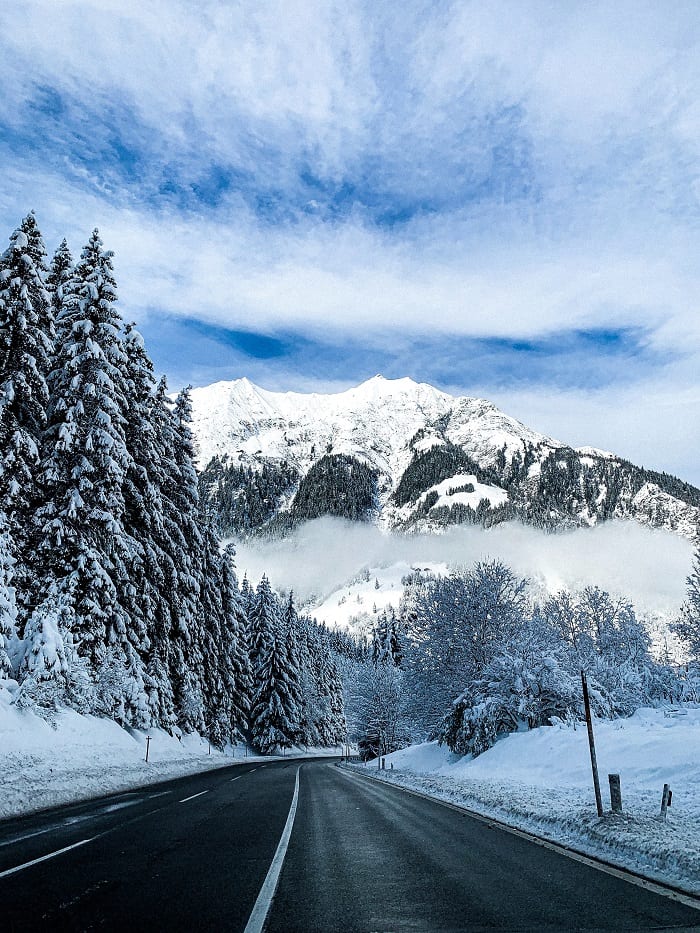
If you’re nervous about driving on the continent – don’t be! French autoroutes are great – they’re generally very quiet and feature regular stopping places (aires) that simply offer a few picnic benches and bathroom facilities, rather than the UK service station type, although these are also available. There are generally three lanes, and you can often be driving for stretches and feel like you’re the only vehicle on the road! They’re well signposted and pretty easy to follow, although with Google Maps as well, it’s hard to go wrong.
Going through toll booths
There is a cost to the autoroutes however, and you can expect to pay around €80 each way in tolls, payable in different sections at the ‘péages’. You can pay in cash if you wish but mostly you can just pay contactless, so it’s quick and easy.
- Pull up to a toll booth. If in doubt, look for the green arrow ones.
- Wind down your left side window.
- Pick up a ticket which comes out automatically from the machine and keep it safe.
- Wait for the barrier to go up and drive onwards, filtering into a lane and watching for traffic merging on both sides.
- Drive until the next péage then insert your ticket as instructed.
- The price will appear and you can pay by card or cash.
There’s also an easier way if you want to just cruise through the peages without having to deal with tickets and machines: the ‘Bip and Go‘ in-car sensor means you don’t have to stop to go through the tolls (just slow down). A sensor near the barrier recognises your vehicle’s presence and payment is taken automatically. You just need to order it in advance of your journey, and set up the payment method. Usually it is shipped within 72 hours so it’s not a last minute option.
Driving an electric car to France
Good to know
- If you take your own picnic, flask and snacks, you can save quite a bit compared to purchasing drinks and sandwiches at the service stations.
- The cost of diesel is generally lower in France than the UK, petrol is roughly similar.
- To avoid filling up on the motorways, there is a garage located near ‘Majestic Wine’ in Calais which offers more reasonably priced fuel. Depending on your car size, this could well last you the whole journey to the ski resort!
What is the route from Calais to the Three Valleys?
It takes roughly 9 hours to drive from Calais to Courchevel / Méribel (without stops) and is just under 1000km.
It is not a difficult route at all, and the major cities are: Arras, Reims, Troyes, Dijon, Lyon and Chambéry. (It might happen that Google Maps gives you an option to go via Paris. Unless you specifically want to go via Paris, you don’t need to! Check the route as above.)
When passing Lyon, it is advisable to follow the St Exupery Airport signs (to avoid going closer to the centre), then continue on to Chambéry.
You will then pass Albertville and Moûtiers.
At Moutiers, look out for you signs to Courchevel and Meribel. You will pass Super U supermarket (fill up with fuel here if needs be) then begin winding up the mountain following sign posts (the road splits into two lanes, one for Courchevel, the other for Meribel).
For La Tania, go through Courchevel Saint Bon and into Courchevel Le Praz, where you need to take a right towards Meribel. (past the Alpinium lift station and the ski jumps).
For Meribel, stay right on the main road after Super U and keep following signs to Meribel Centre.
- See our chalet pages for individual chalet locations
Our guests also recommend taking it easy and stopping over for a night on the way: “Think about your travel as part of your holiday (read about the ‘slow travel movement’ for inspiration), also maybe combine with a stopover and see a bit more of France (a tour of Champagne houses near Reims for instance…)”
But please be aware that driving into some French cities means you need to take into account the low emission zones: Paris, Lyon, Lille, Chambery, and Grenoble and order in advance and display the appropriate ‘vignette’ (sticker) in your windscreen, Find out more or see below**.
Parking in Le Praz or La Tania
There is free outdoor parking in each resort.
- For our La Tania chalets, there is free exterior parking close to all chalets (see individual chalet pages for details)
- In Le Praz, free parking is available on the drive of Chalet Chu Lo Dou.
- In Meribel, you can park close to Chalet Loden.
If you prefer covered parking, Le Praz has a large indoor car park (Alpinium).
Driving in snow
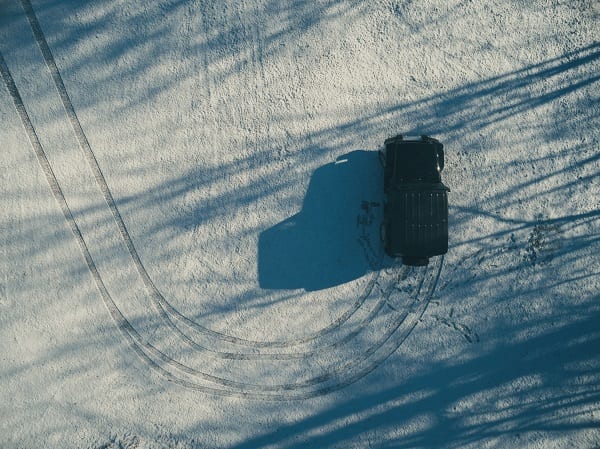
This is where most people understandably feel nervous, especially if having driven in icy and slippy conditions on UK roads, without snow chains or tyres. Being properly equipped makes driving in snow much less stressful. Here’s what you need to know:
IMPORTANT: It is now part of French law that for vehicles driving in certain regions (Alps, Pyrenees, Jura, Vosges, Massif Central, Corsica) 1between November to 31 March, winter equipment is mandatory.
There are three legal options for driving in snow:
1) Snow tyres rated 3PMSF “3 Peak Mountain Snowflake” on all four wheels. (Expensive but extremely reliable)
2) Snow chains for at least two drive wheels. (Tricky to put on but much cheaper)
3) Snow socks for at least two drive wheels. (Cheap and easy to put on, but not very durable over longer distances)
The good news is that it’s actually relatively rare that your tyres will be touching snow – when it is snowing, the first thing that gets cleared is the main road in and out of resort. Courchevel’s snow-clearing team have excellent equipment and a huge investment in keeping those roads as free from snow as possible.
However, if it is snowing on the day you are arriving or departing, you may need to put on snow socks/chains as you get higher up the mountain. There are allocated spaces by the side of the road (called “aire de chainage“) where you can do this and it is very important to stop sooner rather than later to do this, otherwise you risk an accident or blocking the road if you are unable to move your vehicle.
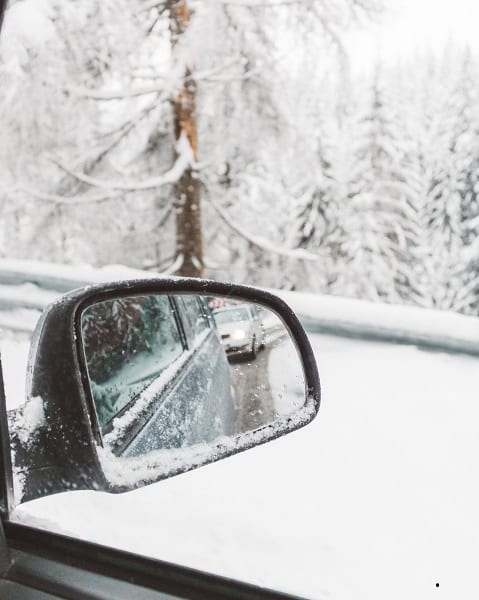
Please note that simply having a 4-wheel drive car does not make it easier to drive in snow!
Top tips for snow chains and snow socks
Snow socks are easiest to put on and take off, but not suitable for longer distances and can wear out quickly. In some places they are not an approved alternative to chains as they are not as effective.
Snow chains work effectively but can be difficult to fit onto your wheels.
The AA guide to snow socks and snow chains
Key to success with snow chains is watching an instruction video and practising in a dry place before you actually need them – preferable before you leave on your holiday!
A useful snow chain video from Cadrona ski resort
Another top tip – pack a shovel, de-icer and some old gardening or ski gloves! If your car is snowed in during your stay, or you need to clear the wheels to put the snow chains on, then you’ll be very grateful for these items!
Essential items for driving in France
These details are for private UK-registered vehicles:
- Remember to drive on the right when driving in Europe!
- Valid insurance and European breakdown cover
- Get a winter service, check tyre pressure, top up with anti-freeze and ensure windscreen fluid works in low temperatures.
- Check that your phone will work abroad.
- Check your credit/debit cards will work abroad as fuel stations can be card only.
- Driving in Europe – you’ll need GB sticker, warning triangle, headlamp converter stickers and high-visibility jacket for each person in the car.*
- Snow chains if driving in temperatures below 8 degrees C, or snow socks. Also pack a small shovel, old waterproof gloves and de-icer.
- Documents required:
- Valid driving licence for all drivers
- DVLA V5 document
- Certificate of motor insurance
- Passport with at least 6 months until expiry
- Find out which documents you will need post-Brexit
It is compulsory to display a GB sticker, and carry an EU standard warning triangle and a high visibility jacket (accessible from inside the vehicle) for each person in the car.
You should also manually adjust your headlights or use a sticker kit to convert them. It is recommended but not mandatory to carry spare bulbs with you.
Breathalyser kits are not a legal requirement (this was indefinitely postponed in 2013) but you should still carry an alcotest in your vehicle even though you cannot be fined if you do not have one.
Post-Brexit potential requirements
RAC guide to Driving in France
** Crit’Air Vignette
France has introduced a legal requirement for driving through certain cities: ‘clean air’ windscreen stickers (‘Crit’Air vignette’). You can easily avoid these areas by using the main autoroutes but be aware that the list of cities requiring a sticker includes Paris, Chambery, Grenoble, Annecy, Dijon and Lyon. On-the-spot fines are between €68 – €135.
Buy a sticker for €5.11 (English instructions)
And finally… what about the bored children?
After many trips back and forth between the UK and France by car, we can confirm that the day or travel will not be the best day of their – or your – life! However, it’s a means to an end and is definitely achievable, especially considering you have no baggage weight limit…
Make sure to stock up on car sickness necessities – to prevent, and also clear up from, just in case the prevention didn’t work! Bin bags, kitchen roll, disinfectant spray are essential to have at hand.
Eye spy isn’t all that exciting on the autoroutes but audiobooks, lengthy playlists, podcasts are all fantastic ways to pass the time, and you can download films and games onto ipads and phones (don’t forget chargers!)
And finally, it could be wise to pre-empt that normal rules on screen time and sweet intake can be relaxed for the journey!
We’re here to help!
Please don’t hesitate to contact us for more information about driving to the Alps this winter. We have made the journey many times and have a wealth of top tips on how to make it stress-free when travelling with – or without – children!
Images
Qendo on Unsplash
Ozark Drones on Unsplash
Emilia-morariu on unsplash
adrian on Unsplash


Nice advice that car owners should follow through. Thanks for it.